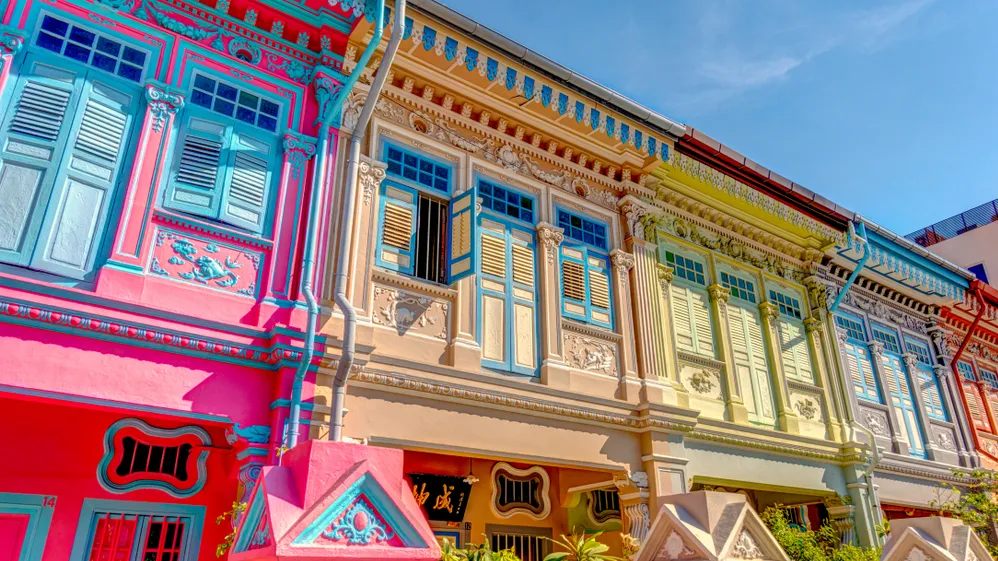
Luxury, wellness brands drive demand for Singapore’s shophouses
These buildings let tenants tell their stories in ways conventional buildings can’t.
Heritage shophouses in Singapore are attracting renewed interest from luxury, wellness, and lifestyle brands, as developers restore conserved buildings to create distinctive retail and dining experiences that modern structures cannot replicate.
Real estate investment firm 8M Real Estate, whose portfolio is 90% shophouses, said these properties allow tenants to tell their brand stories in ways conventional buildings can’t.
“They are seeking very unique locations, especially those with heritage or with a rich culture or history behind them,” Xin Rui, executive director of asset management at 8M, told Real Estate Asia. “For them, it is important because they want to connect with the local markets.”
Beyond food and beverage, wellness operators are moving into heritage units. “One of the trends that has been growing in recent times is the wellness industry — for example, fitness and sports recovery,” she said via Zoom, noting that such tenants value community connection.
Other experiential concepts, such as pottery studios and DIY (do-it-yourself) craft shops, are also driving demand.
Mary Sai, executive director of capital markets at Knight Frank Singapore, described heritage shophouses as “trophy assets” whose prices have been climbing in the past 15 years due to scarcity and the branding benefits of enclave gentrification.
High-net-worth people and family offices often accept lower yields in exchange for capital preservation and prestige ownership, she said in an emailed reply to questions.
Conservation rules keep supply tight, which supports long-term values, said Yap Hui Yee, executive director of investment sales and capital markets at Savills Singapore. Shophouses’ flexibility—accommodating uses from retail and offices to hotels or serviced residences with approval—adds to their resilience.
Compared with other property types, they typically offer lower returns but higher potential for capital gains over time, Sai said. “They carry higher illiquidity risk but are typically not affected by supply cycles that are characteristic of other asset types, such as offices.”
Darren Sabom, managing director of investment management at 8M, said his firm is moving from acquiring single units to buying entire rows or blocks, such as a cluster of 15 shophouses in Tanjong Pagar, to create distinctive precincts.
Whilst these properties can be costly to adapt, the payoff is in the unique atmosphere they create. “A high-end restaurant in a shophouse provides an authentic experience that you don’t get in a hotel or office building,” he said.
Institutional investors including 8M Real Estate, Clifton Partners, and HSBC Asset Management have built significant shophouse portfolios, reflecting growing confidence in the asset class.
Foreign interest has also increased alongside the expansion of family offices in Singapore, which now number over 2,000. Many buyers see shophouses as a hedge against currency depreciation and political uncertainty, especially since the pandemic.
‘Cultural identity’
Strict Urban Redevelopment Authority conservation requirements limit redevelopment and can make renovations costly, especially when preserving heritage facades with modern materials. Even after upgrades for fire safety, accessibility, and mechanical systems, maintenance continues.
Yap cautioned that a property’s approved use can be a major risk. Converting ground-floor spaces to food and beverage outlets, for instance, requires official approval and may be rejected.
“To avoid costly surprises, it is advisable to engage an experienced shophouse broker who can verify permissible uses and guide investors through the regulatory process,” she added.
8M has tried to align each site with its neighbourhood’s cultural identity during tenant curation. “We look at the location, the neighbourhood’s unique culture and identity, and also accessibility,” Rui said. “We look at how we can revitalise or refurbish our building to catalyse change for the neighbourhood.”
The company works closely with tenants and organises events to keep spaces active. At 38 Tanjong Pagar, 8M commissioned a mural depicting Nadim, a boy from local legend who defended his village from swordfish attacks.
“This is one of the simple ways to keep the history alive and help people feel more connected to the place,” said Edwin Ho, senior manager of asset management at 8M.
Adapting these historic buildings is far from straightforward. “Doing a project like this is not a typical renovation,” he said. “It’s more like doing surgery on a 100-year-old patient. You’re dealing with layers of history, old structures, and systems never meant to support modern demands.”
Despite the challenges, Sabom remains optimistic.
“Shophouses exist around the region,” he said. “Singapore is unique because conservation is so strong. There’s a limited supply, and as long as foreign nationals want to acquire property, the demand will only grow.”




 Read Here
 Advertise
 Sign Up